AI training is becoming one of the biggest capacity advantages a business can build right now. The AI race is entering a new phase, and the teams that create room to learn, test, and implement are going to feel the difference first.
The AI Race Is Accelerating
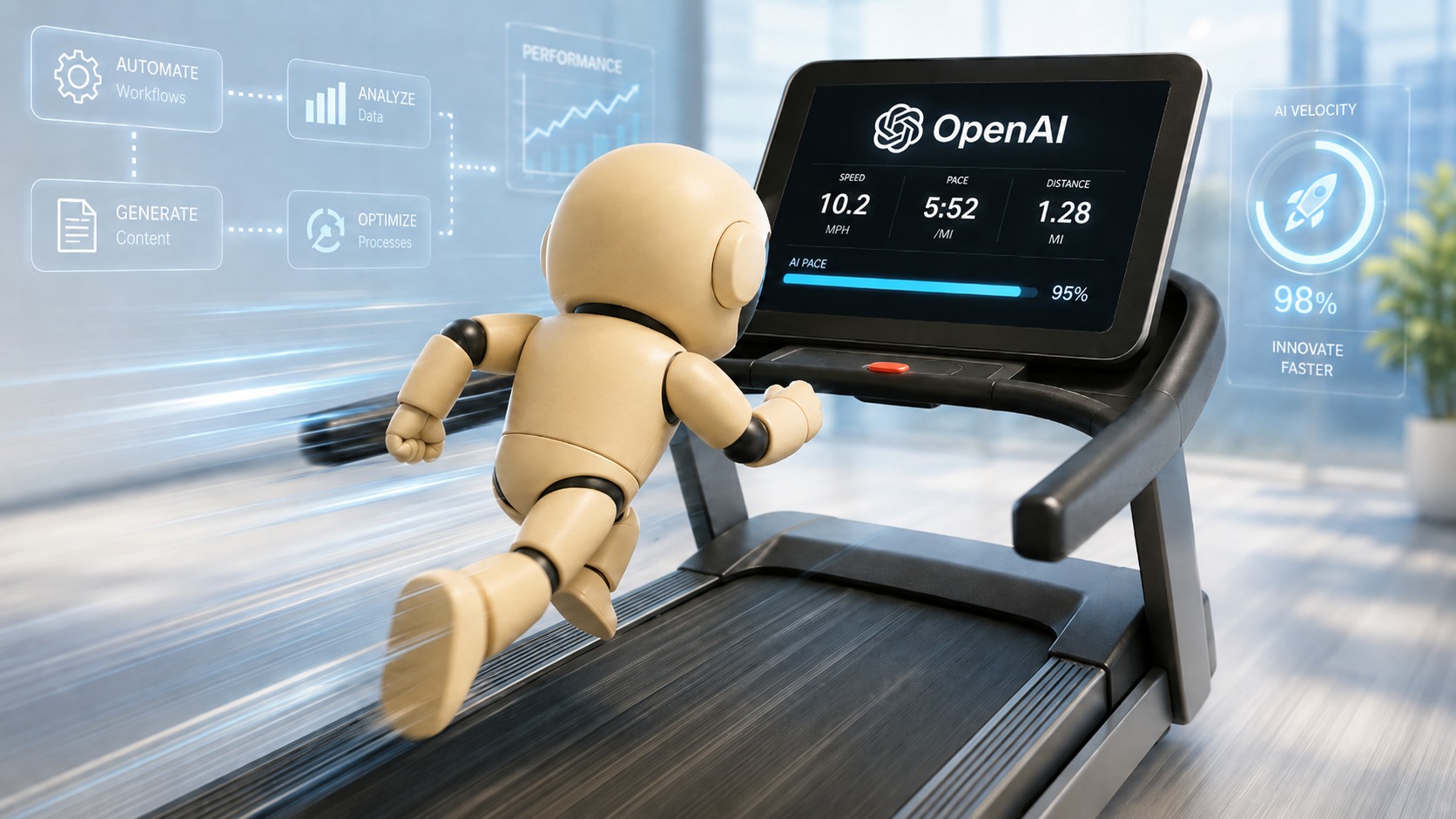
OpenAI. Anthropic. IPO conversations. New releases. Bigger tools. More competition. More pressure to prove value.
And honestly, for those of us who love building with this technology, that competition is producing some incredible tools. We are loving every second of it.
But here?s what I?m seeing at the grassroots level with chambers, associations, small businesses, and lean teams:
The technology is advancing faster than most people have time to absorb it.
That creates a real challenge.
Some people are still trying to learn the basics: how to prompt, how to use ChatGPT well, how to save time on everyday work.
Others are already building agents, automations, custom tools, internal dashboards, workflows, apps, and platforms that redefine how their organizations operate.
The Real Gap Is Time
And the difference is not always talent.
It is not always spending power.
In many cases, the difference is time.
The people and organizations that can make room to test, experiment, break things, rebuild, compare notes, and apply AI to real problems are pulling ahead quickly. That is what practical AI capacity looks like.
The people who know AI matters, but are buried in operations, meetings, customer needs, staffing issues, emails, and daily fires, are having a harder time making the leap.
AI Training Has to Evolve
That is why AI training still matters.
Maybe more than ever.
But the training has to evolve.
It cannot only be ?here are 10 prompts.?
Some people still need that, absolutely. There are still plenty of business owners, employees, nonprofit leaders, and professionals who need help understanding how to write better prompts and use these tools more effectively.
But the bigger opportunity now is helping teams understand how to think with AI, build with AI, delegate to AI, create systems with AI, and decide where AI actually belongs in their organization.
Tools like Codex and Cowork can now do things that would have sounded impossible a year ago. They can research, write, analyze, build workflows, and handle tasks that start to feel like having additional staff.
That?s exciting, but it also raises a real question:
How does a small business owner or chamber executive who just learned how to create their first GPT make the jump to something like that?
This is where the real value of AI is heading. Not just better prompts, but systems that can take work off your plate and help run parts of your organization.
For small teams, this can create big-team capacity.
For larger teams, it can unlock productivity and creativity they may not have thought were possible.
The opportunity is incredible.
The challenge is that it can also be overwhelming to learn, teach, and implement.
AI Training Builds Capacity
So how does an organization make that leap?
There are really two paths.
The first path is to bring in outside help. Work with someone who is already building, testing, applying, and translating this technology into practical business use. That reduces the on-ramp and helps the organization move faster.
The second path is to build the capacity internally.
But that requires more than telling people to ?use AI.?
It means giving them time and permission to experiment.
One thing I?ve been encouraging businesses and chambers to do is hold a regular internal AI meeting. Once a month is enough to start.
Ask simple questions:
- Current AI experiments
- Time-saving wins
- Failed tests and lessons learned
- Automation opportunities
- Member, customer, or operational problems to solve next
That kind of rhythm matters because AI adoption is now beyond just learning a tool.
It is becoming an organizational habit.
Organizations can also use an AI opportunity evaluation or an AI implementation sprint to identify where AI training will create the most immediate value.
Making AI Training an Organizational Habit
I?ll be honest: I have an advantage here. I run an AI company. I can spend the day building, testing, experimenting, creating tools, and applying what I learn for clients and for the organizations I work with. As a result, I now have AI helping with business development, admin, marketing, ideation, research, networking, and follow-up – often working while I?m in meetings, on the road, or asleep!
Many people in the workforce do not have that luxury.
They are not behind because they are not smart enough.
They are behind because they have not been afforded the capacity to begin.
That is why consultants, trainers, and internal AI champions are going to matter so much in this next phase.
Because the widening gap is not really between the ?haves? and the ?have-nots.?
It is between those who have created capacity to build with AI? and those who are still trying to find the time to begin.
I am a zealot about empowering companies, chambers and associations with AI.
I love when people come back to me and tell me that they went through our AI training and are now doing X, Y and Z with AI to grow, optimize or tell a stronger story.
For that, I’m going to keep training.
When I do, I always start by saying that my goal is to Educate, Inspire and Empower.
I also emphasize that “empower” is the one that’s going to make all the difference going forward – whether it’s you, personally, believing that AI can solve real-world challenges for you… Or you, as a leader, giving your employees the time, tools and room to roam when it comes to AI.