Data Centers: What Every Community Should Be Asking
Whenever I get into a conversation about data centers, I usually start with something that seems to get lost in the debate: nobody is giving up their technology. We’re still going to use AI, order from Amazon, scroll through Facebook, have dinner delivered, call an Uber and play Madden 27 online. All of that depends on digital infrastructure… somewhere… even when we don’t think much about where it is.
So, yes, I’m pro data center. I think there’s real opportunity for communities in this investment, and I don’t see the demand for the services they support going away. But that doesn’t mean we should build them wherever someone happens to find a piece of land, or accept whatever terms a developer puts in front of us.
Like a lot of controversial issues, I think the useful conversation is somewhere in the middle. A developer wants to build, and a community wants to know what this means for the people who live there. That’s a conversation worth having, because the answers can change what gets built and what the community gets out of it.
What would make this a good deal for us
From an economic-development perspective, I want communities to recognize that they have something to bring to the table. If a developer is interested in your town, there’s a reason. Before you start celebrating the investment announcement, figure out what your community would need to make this a good project: the right location, the right design, a worthwhile financial return and a clear understanding of who pays for what.
Residents belong in that conversation, too. Someone who lives next to the proposed site is going to think about it differently from someone looking at the county’s tax base. Both perspectives can help you ask better questions before decisions are made.
This is why blanket moratoriums concern me. I worry about the message they send beyond the project itself. If I’m considering another kind of investment, am I going to wonder whether my industry could be next? If a community needs time to understand its capacity or prepare rules, explain what that work is and how it leads to a decision. I’d rather see us come to the table knowing what we want and what we can reasonably negotiate.
Begin with why here
The first thing I’d ask is, why have you chosen our community? Is it the power, the fiber connections, the land, the climate or access to customers? Understanding what makes your location valuable helps you understand your negotiating position, along with the other places the developer could go.
I remember being at the opening of Yahoo’s data center in Lockport, NY about 15 years ago, when I was working with the regional chamber. Everybody wanted to be as close to the center of that ribbon-cutting as possible - including many people who are opposing data centers today. One of the things we talked about that day was something those of us in Western New York know very well: it’s cold here for a good part of the year. For this project, that was an advantage.
Yahoo’s report to the Department of Energy explains that the site was chosen for its favorable climate and that the facility’s design used outside air to cool the servers. It became operational in September 2010. So the connection between our weather and that particular investment was part of how the facility was designed to work. [1]
I’m simplifying the engineering, of course, but that’s the point of asking. Have the developer explain how your local advantages fit the proposed design, and consider what else that land and infrastructure could support. Then you can have a more informed conversation about the terms.
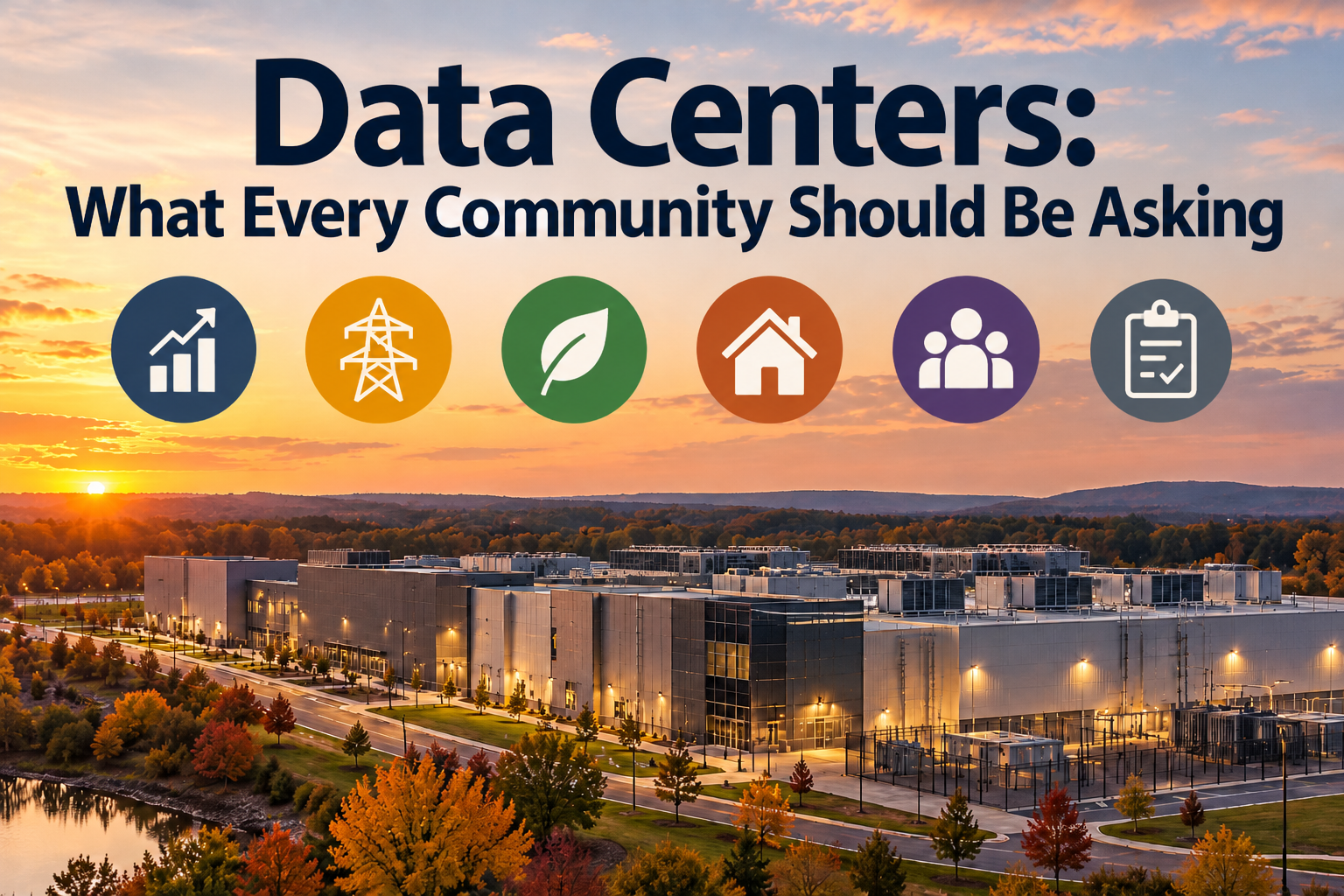
Six questions to bring to the table
1. What does our community get out of the deal?
When someone announces a huge investment, I want to know what that means for the community’s finances. How much revenue comes in, which public bodies receive it, and what have we agreed to give up or pay for to get it? An investment number on a press release doesn’t answer those questions. And walk through what happens if the project changes. If only part of it gets built, or it takes longer than expected, does the financial picture still make sense?
Jobs belong in the discussion, too, but construction jobs and permanent operating jobs are different things. Be clear about both, along with the wages, local purchasing and opportunities other businesses might have to participate.
Note: “They’re only temporary jobs” is a popular pushback on data centers. But all construction jobs are temporary jobs. Thriving communities keep their construction workers busy.
2. Who is paying for the infrastructure?
If the project needs more power capacity, a new water connection or road improvements, somebody has to pay for those things. I’d want the developer, the utility and the community to explain their respective responsibilities together, so residents can see where the costs land and what happens if the project uses less capacity than planned.
If the company proposes generating its own electricity or selling excess power back to the grid, I’d want to understand how that works for the people already paying electric bills here. Who pays for the connections and backup service, and what happens during peak demand? If lower bills are part of the pitch, show us how those savings reach residents and what commitments support that promise.
Even President Trump weighed in on this issue just last week. On October 21, he said he was mandating that large new data centers generate their own electricity and provide or sell any excess power to the local community or grid. He also suggested that developers pay a financial dividend to the communities hosting them. [5]
How those statements translate into enforceable requirements remains to be seen. But I think the larger questions are important: Who pays for the infrastructure, how are existing ratepayers protected, and what does the host community receive in return?
The employers already there matter in this conversation. They need reliable service and room to grow, too. A major new investment should be evaluated alongside what the rest of the community needs from its infrastructure.
3. What are we asking for on the environmental side?
Environmental questions should be part of the discussion early enough to affect the design. Ask how much electricity and water the facility expects to use, how it will be cooled and how backup generators will operate, including during periods of high demand.
There are ways to improve performance. The Department of Energy describes cooling approaches that can reduce energy and water use, with the results depending on the design, operating conditions and climate. It also explains how evaporative cooling consumes water. That’s why I’d want to understand the whole system rather than stop at a label like closed-loop cooling. [2] Give the company an opportunity to show you what it can do, then get specific about what will be measured and reported. Environmental improvements can (and should) be part of what the community asks for.
4. What will it be like to live near this?
Put yourself in the position of someone living nearby. What will they hear? What will they see at night? How will construction traffic affect their road? Those are reasonable questions, and they’re much easier to address while you can still influence the location, layout, buffers and operating plans.
Residents should also know where to go if something isn’t working as expected, who will look into it and how the community will check the project’s performance. Include the longer view while you’re talking about the site. What happens as it expands, changes owners or eventually reaches the end of its use?
5. What would make a difference for our community?
This is where I think communities should spend more time thinking about what they want. What would make a meaningful difference locally? It could involve education, workforce preparation or infrastructure, but the priorities ought to come from the community.
Then ask how the proposed benefit would work. Who receives it, when does it arrive and who decides how it gets used? A one-time contribution and a recurring source of revenue can both be useful, but they do different things for a community.
I’d also be open to asking whether residents could benefit directly, through something like a community dividend. If we’re putting that on the table, let’s talk about who qualifies, how it’s funded and whether it continues over time. I’d want those benefits considered alongside the tax contribution, infrastructure costs and environmental commitments, so we can understand the whole deal.
6. How do we make sure the commitments happen?
If a commitment matters to the decision, find out where it appears in the approvals or agreements, who checks that it happens and what follows if it doesn’t. I’d also want to know what carries forward if the property is sold or the project is redesigned.
You’ll need people who understand the planning, utility, financial, environmental and legal pieces. Their work should help local leaders explain the deal clearly enough that residents can understand what they’re being asked to support and how it will be followed through.
Look at what other communities are asking for
Look at Columbia County, Georgia. Its economic-development authority’s August 26, 2026 announcement describes residential buffers, a noise limit, lighting controls, cooling requirements and a decommissioning requirement for the proposed data center. Those are specific conditions that other communities can examine as they consider what they would want for their own sites. [3]
In Pike County, Ohio, the PORTS-Pike Technology Campus website says SB Energy and OpenAI have committed $80 million to a community-benefits fund. The site describes a project being developed in phases, with capacity expected to begin coming online in 2028. That’s a substantial commitment, and I’d want to understand how the money will reach local priorities over time. [4]
These examples are reasons to get into the details. They show conditions and commitments communities can study, while the eventual results still have to be delivered. Your community’s circumstances and negotiating position will be different, so use the examples to develop questions and evaluate your own proposal.
When I make this argument, someone will usually point to a bad deal somewhere else. And if a community gave away too much or didn’t get what it expected, that deserves scrutiny. But I don’t think a bad deal settles whether your community should consider a proposal. I think it makes the case for understanding the terms and negotiating them well.
Why am I saying all of this?
Because everywhere I go around the country, speaking at chamber of commerce conferences and, increasingly, economic development summits, the data center question keeps coming up. I'm being asked to talk about it, and understandably so. You can't have a serious conversation about what AI means for economic development without talking about the infrastructure needed to support it.
I've spent more than 20 years working with chambers of commerce and in economic development. Today, I'm also an AI consultant. That puts me in an interesting position. I understand the economic development opportunities communities are looking for, and I understand the technology that's driving this enormous demand for infrastructure.
And what I'm seeing is a lot of chamber and economic development leaders trying to wrap their heads around a complicated issue while navigating an increasingly volatile public conversation.
I think we need to get past the arguments about whether data centers are inherently good or bad and start having more productive conversations about what they mean for our communities.
There is more to the AI economy than data centers
There’s another piece of this I don’t want communities to lose sight of. A data center may be the biggest AI story in town, but the local businesses, nonprofits and other employers are still trying to figure out what AI means for them.
Helping an existing company improve how it operates, helping someone test a new business idea or giving employees a chance to learn useful skills is economic development, too. Chambers, educators, workforce organizations and economic-development leaders have a role in bringing those conversations together, even while an infrastructure proposal is being debated.
My starting point is that I’d like to have the conversation. If a developer wants to come to your community, find out why, explain what matters to the people who live there and see whether you can put together a project that works. You can be interested in the investment and still be demanding about what it takes to earn the community’s support.
The question I’d like us to spend more time on is this: here’s what our community would want from a data center. Can we make that happen?
Sources
- Yahoo report for the Department of Energy on the Lockport facility, September 13, 2011.
- Department of Energy guidance on data-center cooling water efficiency.
- Columbia County economic-development authority announcement, August 26, 2026.
- PORTS-Pike Technology Campus project website, accessed October 18, 2026.
- Reuters: Trump says companies should pay 'dividend' to communities to make data centers popular, October 21, 2026.