What It Really Takes to Put AI to Work in Your Organization
Over the past few months, I’ve been working with businesses on AI implementation and talking with leaders around the country about what AI could mean for their organizations.
There’s a lot of excitement. And there should be.
We can do things today that would have seemed almost impossible just a couple of years ago. We can develop customized applications, automate work that has consumed countless hours, and build systems around the way a company actually operates.
But as I drove home from North Carolina last week, I kept thinking about something else.
The questions people have been asking me aren’t necessarily about the technology.
They’re about the people. The time. The resistance. The decisions. And what happens after somebody gives an impressive AI demonstration and says, “Imagine what we could do with this!”
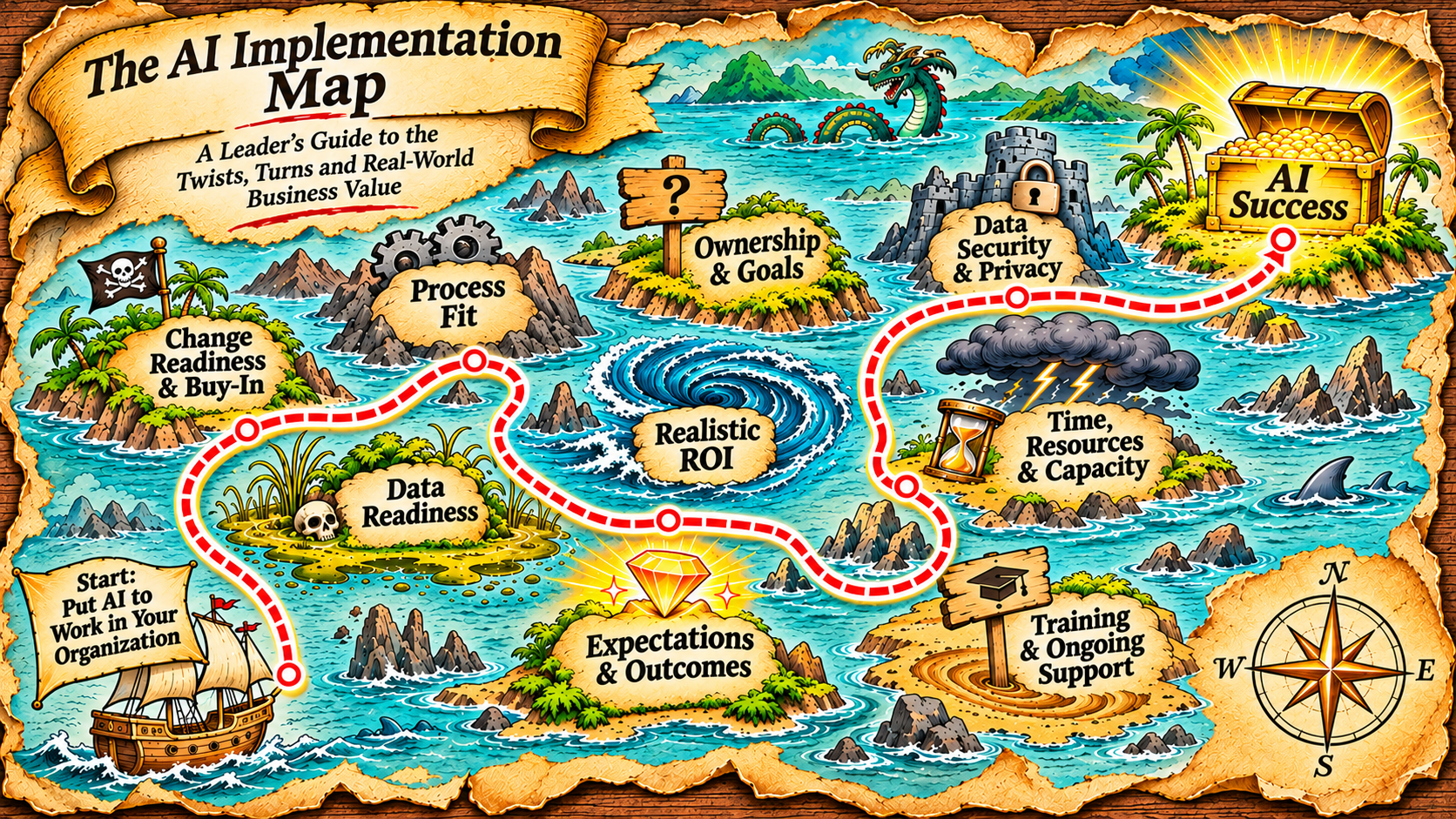
So I thought it might be useful to talk about what implementing AI really looks like.
Because there’s tremendous opportunity here. But there are also some things leadership should expect along the way.
Start with “There’s got to be a better way to do this.”
Somebody in your organization has probably said that this week.
Maybe they were copying information from one system into another. Maybe they were trying to find a document nobody has seen since 2019. Maybe they were sitting through another meeting trying to figure out why three departments have three different versions of the same information.
We’ve all been there.
And that’s a terrific place to start thinking about AI.
But there’s a difference between recognizing that something should work better and actually changing the way it works.
AI can help you build tools around the way your company operates, bring information together, and give your employees more time to do the things you actually hired them to do.
But buying a subscription doesn’t make that happen. Neither does watching somebody demonstrate an amazing new AI application.
The real work starts when you ask, “What would it take to make this work in our company?”
Expect to discover how your company really operates.
You probably think you know how things get done in your organization.
And you probably do.
Mostly.
But then you start talking to the people doing the work.
There’s the official procedure. There’s the procedure everybody actually follows. There’s the workaround somebody created three years ago because the official procedure never worked properly.
And there’s always that one person who knows how to fix everything.
You know who I’m talking about. The person everyone calls when something goes wrong, because nobody else has any idea how the system works.
Now imagine trying to automate that process without knowing any of those things.
You might end up making a bad process work faster. Congratulations!
This is why understanding the work matters so much.
You need to listen to employees, find out where things get stuck, and understand why people do things the way they do.
And here’s something I love about this: Even if you never implemented a single AI tool, your company would probably benefit tremendously from having these conversations.
AI is giving us a reason to take a fresh look at how we work.
That’s a pretty significant benefit all by itself.
Expect somebody to hate AI.
Not everybody is going to be excited.
Some people will be fascinated. Some will immediately start thinking about all the things they could do with it.
And some will sit in the back of the room with their arms crossed, looking at you like you’ve just announced that you’re replacing the entire staff with robots.
I’ve seen it.
Some people genuinely hate AI. Others are worried about losing their jobs, being expected to learn another system, or having technology make decisions they’ve spent years developing the expertise to make.
You can’t ignore that. It’s real.
And you probably aren’t going to change their minds with another demonstration of how quickly ChatGPT can write an email.
Leadership needs to understand what’s behind the resistance.
Are people concerned about their jobs? Their responsibilities? The reliability of the technology? Whether anyone is going to listen when they say something isn’t working?
Those are conversations worth having.
I like to use the example of a salesperson not wanting to spend hours entering information into a CRM – a very real problem that absolutely predates AI.
You didn’t hire that person because you wanted someone who was exceptionally good at filling out database fields.
You hired them to develop relationships and sell.
If AI can take a substantial amount of that administrative work off their plate, think about what that person could accomplish with the additional time.
But employees need to understand that opportunity, too.
And here’s the other reality: You can build the most technically impressive AI application in the world.
If nobody wants to use it on Monday morning, what have you accomplished?
Expect leadership to actually lead.
“We should be doing something with AI.”
I hear that a lot.
And it’s a perfectly reasonable place to begin.
But eventually somebody needs to answer a more important question.
What are we trying to accomplish?
Are we trying to improve customer service? Make better decisions? Reduce repetitive work? Help the company grow without continually adding administrative overhead?
There’s no shortage of possibilities.
But somebody needs to establish the priorities and decide what success should look like.
Here’s an example I use frequently.
Let’s say somebody in your organization performs a task that takes an hour. You introduce AI, and now that same task takes 30 seconds.
Fantastic.
What are you going to do with the other 59½ minutes?
Seriously.
Are you going to serve more customers? Improve the quality of your work? Pursue business opportunities you never had time for? Give that employee some breathing room?
That’s a leadership decision.
And it’s a much more important decision than which AI platform you’re going to purchase.
AI can create capacity. Leadership determines what the organization does with it.
Expect to invest some time before you get time back.
This is one that occasionally surprises people.
We’re going to use AI to save everybody time!
Wonderful.
But first, somebody needs to explain the process. Somebody needs to find the information. People need to test things, identify problems, provide feedback, and learn how the new system works.
That takes time.
A relatively simple application might come together quickly. Something involving multiple departments, several databases and years of established procedures is going to require more attention.
And that’s okay.
What concerns me is when organizations want all the benefits but aren’t willing to give employees the time to help make them happen.
Here’s another way I encourage leaders to think about it.
Suppose I give somebody two hours to experiment with AI this week.
And during those two hours, they find a better way to accomplish something that saves the organization two hours every single week going forward.
Was that a good investment?
Of course it was.
But it requires leadership to give people permission to experiment.
And yes, sometimes they’re going to try something that doesn’t work.
That’s part of it.
You can’t tell people to innovate and then be tweaked every time their first attempt isn’t perfect.
A good implementation partner can handle much of the research, development and coordination. But your employees know things about your company that an outside consultant simply doesn’t.
You need both.
Expect some uncomfortable conversations about your information.
This isn’t necessarily the most exciting part of AI implementation.
But it’s important.
Think about the information your organization has collected over the years.
Customer records. Employee information. Financial data. Internal procedures. Documents scattered across shared drives, individual computers and filing cabinets.
Now you’re talking about making some of that information easier to access and use.
That’s an incredible opportunity.
It’s also a reason to have some serious conversations about who should have access to what.
Just because AI can retrieve information doesn’t mean everybody in your company should be able to see it.
And just because an employee can upload something into an AI platform doesn’t mean they should.
The tools you choose need appropriate security and data controls. Your organization also needs clear policies governing how those tools are used.
The two need to work together.
I’ve sat through more cybersecurity presentations than I can count.
You’ve probably seen them, too. The presenter puts a giant map on the screen showing cyberattacks coming from different countries. There are flashing lights and lines shooting all over the globe.
It’s quite a show.
And then we start talking about the ordinary human mistakes that create security problems.
Somebody clicks a phishing email.
Somebody shares information with the wrong person.
Somebody throws confidential documents in the trash.
Not quite as dramatic as the giant map, is it?
But it’s what happens.
Here’s the opportunity: Implementing AI can force your organization to become much smarter about how it handles information in general.
And those improvements can make the entire business stronger, whether AI is involved or not.
Expect the first version to be imperfect.
Have you ever watched a technology demonstration where everything worked beautifully?
Of course you have.
The presenter asks the perfect question. The system produces the perfect answer. Everybody is impressed.
Then Monday morning arrives.
A customer asks something nobody anticipated.
Two departments use the same word to mean completely different things.
Somebody enters information incorrectly.
And suddenly your amazing new system is doing something nobody expected.
Welcome to the real world.
This is why I encourage organizations to test things thoroughly.
Once you have an AI application doing something useful, push it a little.
Ask questions. Try unusual situations. Find out what happens when information is missing or someone does something differently than expected.
And listen to the employees who tell you something isn’t working.
They’re helping make the system better.
One other thing: Speed isn’t everything.
If AI completes a task in ten seconds but somebody has to spend 20 minutes checking and correcting the result, you haven’t necessarily accomplished very much.
You want something people can actually depend on.
And don’t expect the first version to be the last.
Your business will change. Your needs will change. And AI itself is changing so quickly that capabilities we consider impressive today may seem ordinary six months from now.
That’s part of what makes this so exciting.
You don’t have to change everything at once. But you should be thinking about everything.
After reading all of this, you might be thinking, “This sounds like a lot of work.”
It can be.
But it doesn’t have to become some enormous, multiyear technology initiative.
You can begin with something manageable. Something that genuinely makes work better for a group of employees or solves a problem that’s been frustrating your organization for years.
And you can learn from there.
At the same time, I encourage leaders to think beyond individual applications.
What happens when information can move more easily between departments? When employees can access the knowledge they need without tracking down three different people? When systems are designed around the way your company works rather than forcing your company to work around its systems?
That’s where things start getting really interesting.
And it’s where I believe some of the biggest opportunities for businesses are going to emerge.
We’re still in the early stages of understanding what AI can make possible inside our organizations.
There are going to be surprises. There will be things that don’t work. There will be employees who resist, processes that need rethinking, and probably more than a few moments when somebody asks, “Why did we ever do it that way?” (This seems to happen to me every day!)
But there’s also the opportunity to build something better.
Something that gives your organization more capacity, helps your people do their jobs more effectively, and creates possibilities you might not have considered before.
That’s the work we’re increasingly doing with companies at Momentum AI.
And it’s some of the most interesting, creative and rewarding work I’ve ever done.
If your people are already saying, “There’s got to be a better way to do this,” I’d encourage you to pay attention.
They may be telling you exactly where your next big opportunity begins.